Javier Muñoz on CNN: Military Bans on Recruits Living with HIV Will Fuel Discrimination — Proposed Federal Cuts to HIV Funding Will End in Death
“Without access to HIV treatment, people will die…it’s murder.”
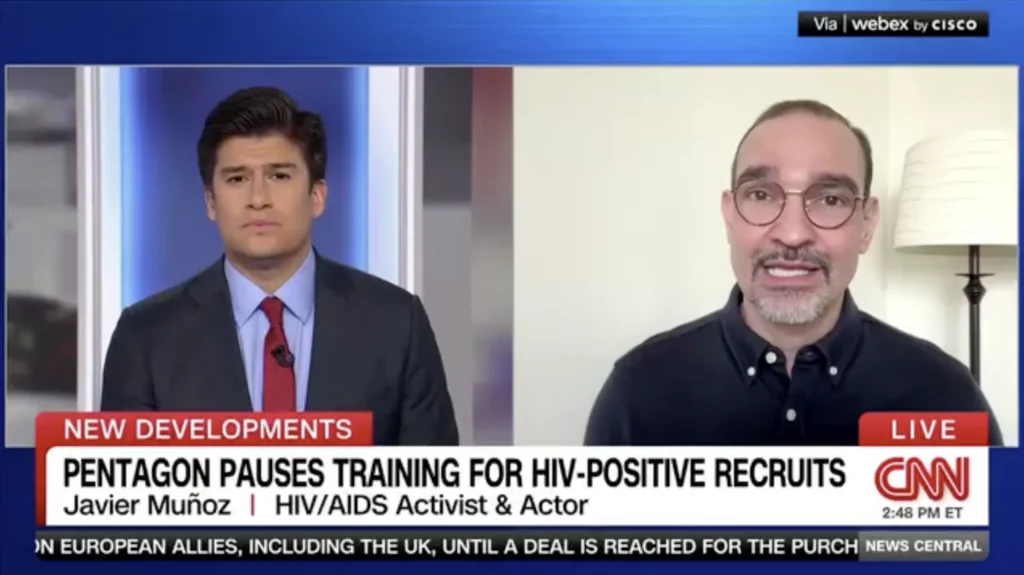
NEW YORK, NEW YORK — MONDAY, JANUARY 19, 2026 — Actor and HIV/AIDS activist Javier Muñoz appeared on CNN to condemn the Pentagon’s decision to pause initial military training for recruits living with HIV, warning that the move — alongside current proposed cuts to HIV funding and access to treatment & care — represents a dangerous rejection of medical science with deadly consequences.Muñoz, who has lived openly with HIV since 2005, and maintains an undetectable status through daily treatment, called the Pentagon’s actions discriminatory and unfounded.
“This is not based on medical fact, plain and simple…People living with HIV who have access to treatment can achieve undetectable status, which means we cannot transmit the virus to anyone else and can live perfectly healthy, normal lives,” Muñoz said.
Addressing claims that HIV-positive recruits are unfit for service, Muñoz spoke from lived experience.
“I take one pill a day. I maintain my undetectable status. My health and physical abilities are as strong as they were when I was performing Hamiltonon Broadway. Anyone [living with HIV and medically undetectable] who wants to serve is military-ready. Period,” Muñoz said.
Muñoz warned that reversing protections for people living with HIV would set a broader precedent for discrimination — especially as HIV funding and treatment access face cuts nationwide, including extremely urgent threats in Florida, closing with a stark assessment of what denial of care truly means.
“Without access to HIV treatment, people will die — To be honest, it’s murder. Any denial of access to treatment will kill people living with HIV,”
Muñoz said.
HIV FUNDING FAST FACTS
To support reporters covering the urgent policy landscape, the campaign is releasing the following Fact Sheet outlining the impact, scale, and human stakes of ongoing funding threats:
HIV funding protects vulnerable communities: Black and Latine communities account for more than 65% of new HIV diagnoses. Protecting these funds is about protecting racial and health equity.
Federal HIV programs have more than 35 years of bipartisan support: In 2003, President George W. Bush created PEPFAR (the President’s Emergency Plan for AIDS Relief), which has saved 25 million lives worldwide. Domestically, Bush signed reauthorizations of the Ryan White CARE Act, expanding federal support for HIV care. Protecting HIV funding has historically been a bipartisan commitment to public health and stability.
Federal HIV programs are cost-effective: Every $1 invested in HIV prevention saves the health care system $3 to $7 in future treatment costs. Cuts would increase long-term spending.
Medicaid is the largest source of coverage for people with HIV in the U.S., covering roughly 40% of people living with HIV. Medicaid expansion has been associated with a 33% increase in PrEP prescriptions. Cuts to HIV funding would have ripple effects across the entire Medicaid system, limiting access to care for millions of low-income Americans.
HIV care is part of the U.S. health care system: Federal HIV funding supports access to preventive care, primary care, mental health services, housing, and medications. Cutting these funds would destabilize programs millions of Americans depend on — including those living with chronic conditions, low-income families, and uninsured people.
Over 1.2 million Americans are living with HIV, and over 500,000 rely on federal programs like the Ryan White HIV/AIDS Program for lifesaving medication and care.
HIV prevention funding protects everyone: The federal government funds access to PrEP (pre-exposure prophylaxis), a daily medication that reduces the vulnerability of HIV by 99%. Rolling back funding would increase new HIV cases and long-term costs to the health care system.
HIV funding is about more than one disease: These programs create a blueprint for coordinated, federally funded responses to health crises — from the opioid epidemic to COVID-19. Gutting HIV funding would weaken America’s preparedness for future public health threats.
Press Contact: [email protected]
About the Save HIV Funding Campaign:
Launched in 2023 by PrEP4All, AVAC, and the HIV Medicine Association in partnership with the Federal AIDS Policy Partnership, the Save HIV Fundingcampaign is supported by over 150 national and local organizations. The campaign began in response to proposed Congressional cuts to federal HIV programs and successfully helped avert $1.5 billion in domestic HIV funding cuts. In early 2025, the campaign expanded in response to the Trump Administration’s escalating efforts to dismantle essential HIV services and infrastructure. Today, Save HIV Funding continues to mobilize advocates, patients, healthcare providers, and public figures to ensure access to lifesaving care for everyone impacted by HIV.
About Javier Muñoz:
Javier Muñoz is an award-winning Broadway actor and longtime HIV/AIDS advocate who has been open about his diagnosis since 2005. Diagnosed three years prior to that at the age of 26, Muñoz has spoken widely about how advances in HIV treatment made it possible for him to fully pursue his career, including originating the role of Alexander Hamilton in Hamilton. He is a Global Ambassador for (RED), works closely with the Save HIV Funding Campaign, and serves on the board of Broadway Cares/Equity Fights AIDS (BCEFA).